Story
How a Med Student Turned 40 Hours of Lectures into a 2-Hour Revision Deck
It's 9pm on a Sunday. Maya's cardio exam is Tuesday morning. She opens her revision deck and starts the first clip — Ninja Nerd's 90-second walkthrough of how preload and afterload differ, around the 12-minute mark of a 50-minute lecture. Then the Osmosis side-by-side of left versus right heart failure. Then the Armando Hasudungan diagram of the cardiac conduction system, building line by line in real time.
Three weeks ago, this deck was 40 hours of lectures she hadn't found time to rewatch. Now it's two hours of clips. The ratio sounds fictional. Here's how she got there.
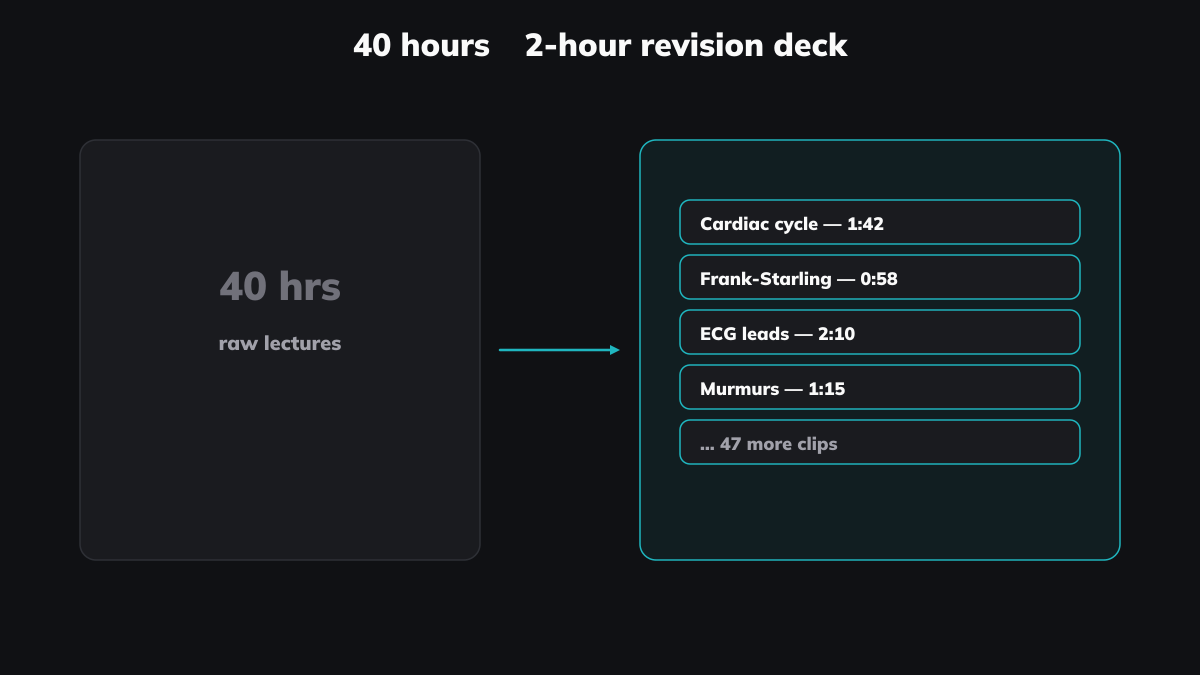
The 40-hour backlog
Med students don't watch one channel. They watch six. A peer-reviewed paper in Academic Radiology (2024) opens by acknowledging YouTube as the first place a medical student turns to for help.
Maya watches Osmosis (Elsevier-owned, embedded in her school's curriculum), Ninja Nerd, and Armando Hasudungan for the diagrams. A Reddit thread on r/medicalschooluk names six channels in one comment — Dirty USMLE for mnemonics, AK Lectures for preclinical basics, Hasudungan as the OG medtube educator, Catalyst University. Plural-channel is the baseline.
Forty hours of lectures means forty hours she'll mostly fast-forward through, hunting for the bits she needs.
The workflow
Maya's workflow is small. Nobody taught it to her.
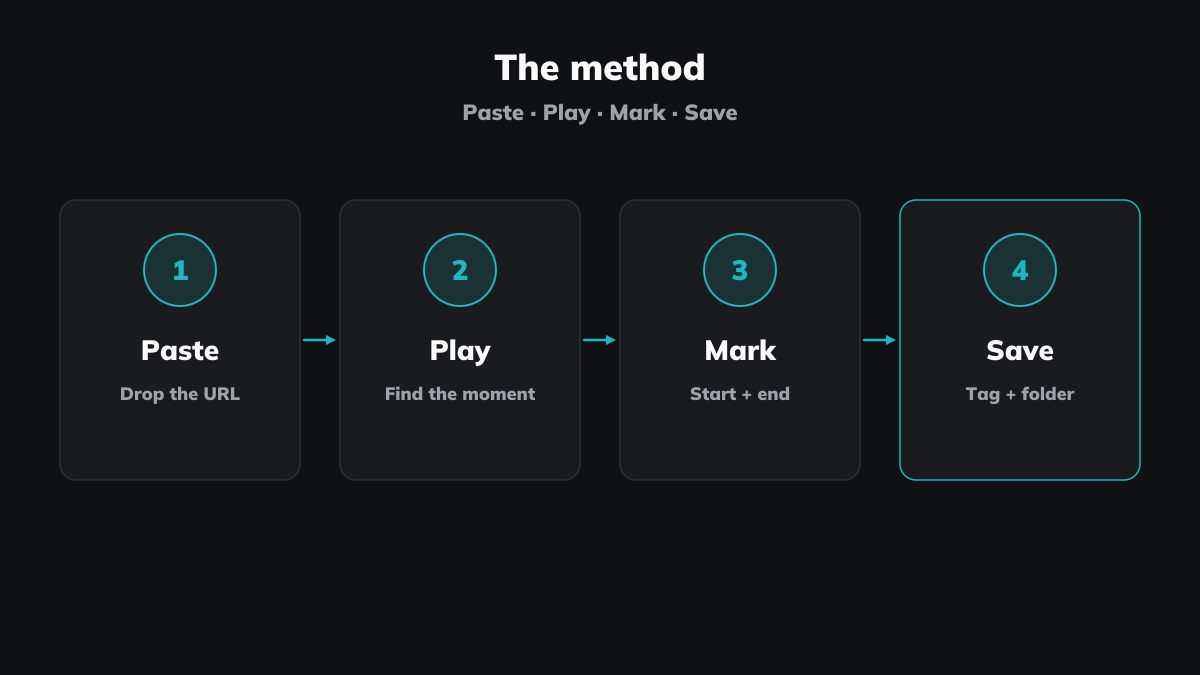
She watches the lecture once. When something lands — the bit where Ninja Nerd draws the Frank-Starling curve, the moment Osmosis side-by-sides left and right heart failure, the Hasudungan diagram of the conduction system as it emerges — she clips the 60 to 90 seconds around it. Tags it. Drops it in the cardio folder. Then keeps watching.
The clipping takes about twenty seconds per moment. Across a 50-minute lecture she'll keep maybe four to six clips. The rest plays through and never comes back.
A week later, reviewing for the cardio block, she pulls up the preload tag. Three clips, three lecturers, the same concept three different ways. She plays them as a sequence — Ninja Nerd first because his version stuck, then Osmosis because the visual is cleaner, then Hasudungan because the drawing settles it. Six minutes total. Finding those three moments across three full lectures would have taken forty.
Watch once, clip what lands, revisit only the clips. In the final week before the exam, she trims again — keeps only the moments she can't reproduce from memory. The two-hour deck is what's left.
What about Anki
Med students reading this are already thinking it. I have Anki. Everyone has Anki. The spacing effect is settled science — a 2022 PMC paper grounds it in Cepeda et al.'s meta-analysis. Med students didn't need this article to find it.
The clip library isn't a replacement for Anki. It's a complement. Anki handles facts — the dosing range for adenosine, the diagnostic criteria for SIRS, the ECG signature of a Wenckebach block. A 90-second Ninja Nerd walkthrough of how preload and afterload interact in compensated heart failure doesn't compress into a flashcard. The explanation IS the value. The build-up to the punchline is the moment that taught you.
Anki for facts. Clips for explanations. Both on a spacing schedule.
Why not summarise the videos
The other answer floating around is AI summarisation — feed the lecture transcript to NotebookLM, get a textbook paragraph out. It looks like compression. It's translation, and the medium it translates into is the one that didn't work for you the first time.
The reason you picked the video was that the textbook paragraph didn't land. The drawing emerging in real time IS the learning. The pause before the punchline IS the learning. A summary throws away the medium that worked and gives you back the medium that didn't.
A clip preserves the moment as it played. You hear the voice. You see the diagram being drawn. You feel the timing of the explanation. None of that survives a transcript.
Beyond medical school
The same workflow shape shows up wherever students are buried in long-form video.
Law students preparing for the bar clip the 90-second hypothetical out of a 2-hour BARBRI lecture and revisit it before the torts exam. Postgrad STEM clips the five minutes of a conference talk that contains the method, skipping the twenty-five minutes of background. Language learners clip native-speaker dialogue from interview podcasts for shadowing practice. Self-taught developers clip Theo's useEffect cleanup at the 14-minute mark and find it again six months later — its own post.
The compression ratio varies by discipline. The shape underneath stays the same.
Sunday night
Back to Maya. It's 11pm. She's done her personal pass. Her study group has a chat — three other third-years, all sitting cardio on Tuesday. She opens her library, picks eight clips from preload-and-afterload plus six from heart failure presentations, and stitches them into a Klipptik. Names it cardio-tuesday-revision. Sends the link.
The Klipptik plays the fourteen clips back-to-back. The source videos still belong to Ninja Nerd, Osmosis, and Hasudungan — they play through YouTube's own player, the channels get the view, nothing was downloaded. The curation is Maya's. The three other students in the chat didn't have that arrangement before she made it.
Her group lead replies within four minutes: send the same thing for renal next week.
The habit
The 40-to-2 ratio sounds dramatic. It's the shape of what's possible after a few exam cycles of getting ruthless about what to keep. The first attempt will be too generous — 40 hours into 12, not into 2. The clips you reach for survive; the rest fade out the next time you tidy the deck.
It's not a productivity intervention. It's paying attention to which 90 seconds of a 50-minute lecture you'll need again — and saving them somewhere you can find.
Start your clip library — free, no account required.