Behind the build
How to Tell If a YouTube Clipper Will Still Exist in a Year
On October 15, 2025, twelve YouTube ripper sites went dark in a single move. Y2Mate, Yt1s, Utomp3, Tomp3, Y2mate.gg — names you'd recognise if you've ever pasted a video URL into a "download as MP4" box. Combined annual traffic across the family: 620 million visits. The operator, based in Vietnam, handed most of the domains over to the International Federation of the Phonographic Industry. No lawsuit. No settlement amount disclosed. Gone.
If your YouTube clipping workflow ran through one of those sites, your library went with it.
Three kinds of clipper, three kinds of question
"Clipper" means three different things on the internet, and the survival question depends on which one you mean.
The republish kind. Stream-highlight channels, VTuber clippers, TikTok edits — take someone else's video, cut a new clip, post it to your own channel. Copyright territory, different question, different post.
The download kind. Y2Mate and its cousins. Paste a URL, save an MP4, build a folder of files on your drive. The kind this post opens with.
The library kind. Save the address of a moment — start, end, video URL — and replay it through the original platform's player. No file, no republish. The clip is a pointer at the source. This is what Klipptik is. This is what the rest of this post is about.
The four ways a YouTube clipper can die
Most clippers die in one of four ways. None of them are speculative.
The download-based tool gets shut down. Y2Mate is the most recent example, but it's part of a pattern — the RIAA and IFPI have been pressuring stream-ripping sites for years, and GitHub took down youtube-dl under an RIAA notice in 2020. The sites come back under different names; TorrentFreak observed after the October 2025 action that ripper sites can be "launched, torn down, and relaunched in the time it takes to eat a sandwich." But the specific site holding your library doesn't.
The scraper-based tool gets caught. Tools that bypass YouTube's official API — scraping pages, using unofficial endpoints — get blocked. Google pushes back. The tool silently breaks. Your library is intact; your videos won't load. Refunds are not common.
The unverified API tool hits the quota wall. YouTube's Data API has a 10,000 unit/day default quota. Enough for a hobbyist. Nowhere near enough for a real user base. Without passing a YouTube API compliance audit, a tool can't grow past that ceiling. Either it stays a hobby project or it tries to scale anyway, hits the wall, and breaks for everyone.
The solo project gets abandoned. This one isn't about compliance — it's about life. A maintainer moves jobs, has a kid, gets bored. The domain lapses. Your library lapses with it.
The will-it-still-exist checklist
Four questions to ask any YouTube clipper before you trust it with a library.
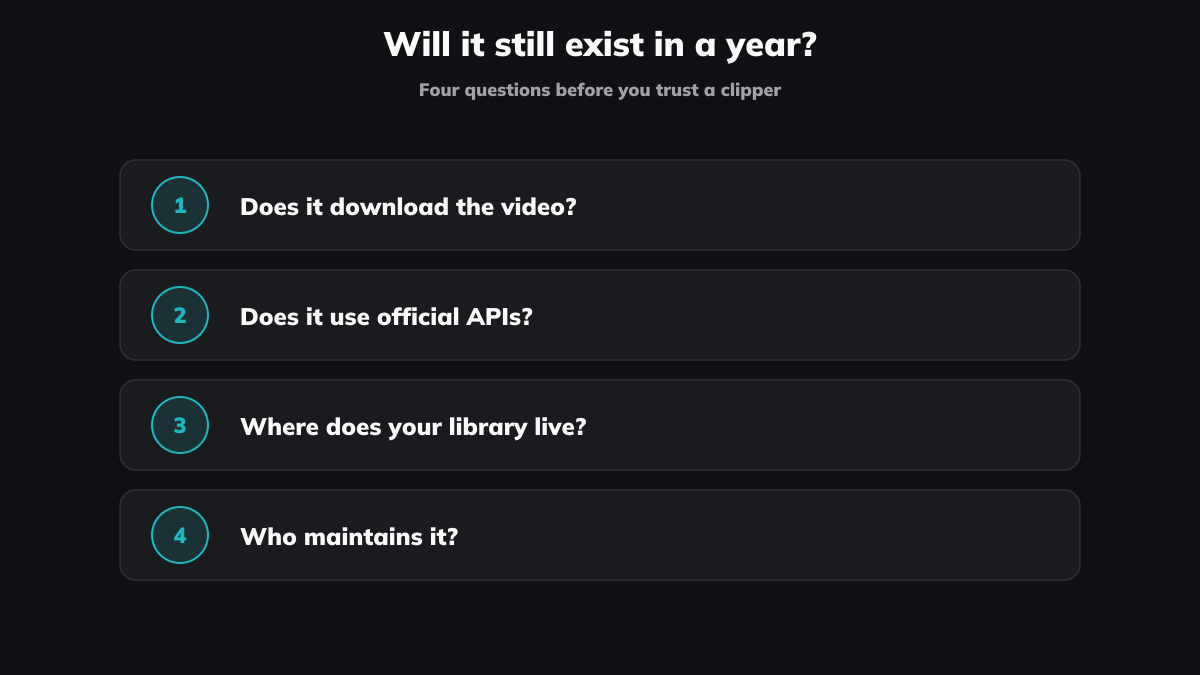
1. Does it download videos, or stream them? Open the tool's homepage. Does it talk about "downloading," "saving as MP4," or "exporting to your device"? If yes, it's a downloader — Y2Mate's category. The IFPI and the RIAA aren't done.
2. Does it store the video, or only metadata? If a clipper claims to "save" your clips, where do those clips live? On a server holding the video bytes? Or as timestamps and references that play back through YouTube's own player? The second is structurally durable. The first is one DMCA notice away from disappearing.
3. Has it passed a YouTube API compliance audit? Anyone using more than 10,000 quota units per day has to pass one. There's no public badge a user can check, but you can ask. Tools operating at scale without an audit are either flying under the radar (won't last) or built on something other than the official API (also won't last).
4. Who maintains it? A team, a company, a solo developer who replies to support emails on weekends only? You don't need a Fortune 500 — you need someone whose incentive structure says "this still has to exist next year." A side project hosted on a free Vercel tier doesn't qualify.
What durable looks like
Two things separate the survivors from the rest: where the video lives, and what the tool stores.
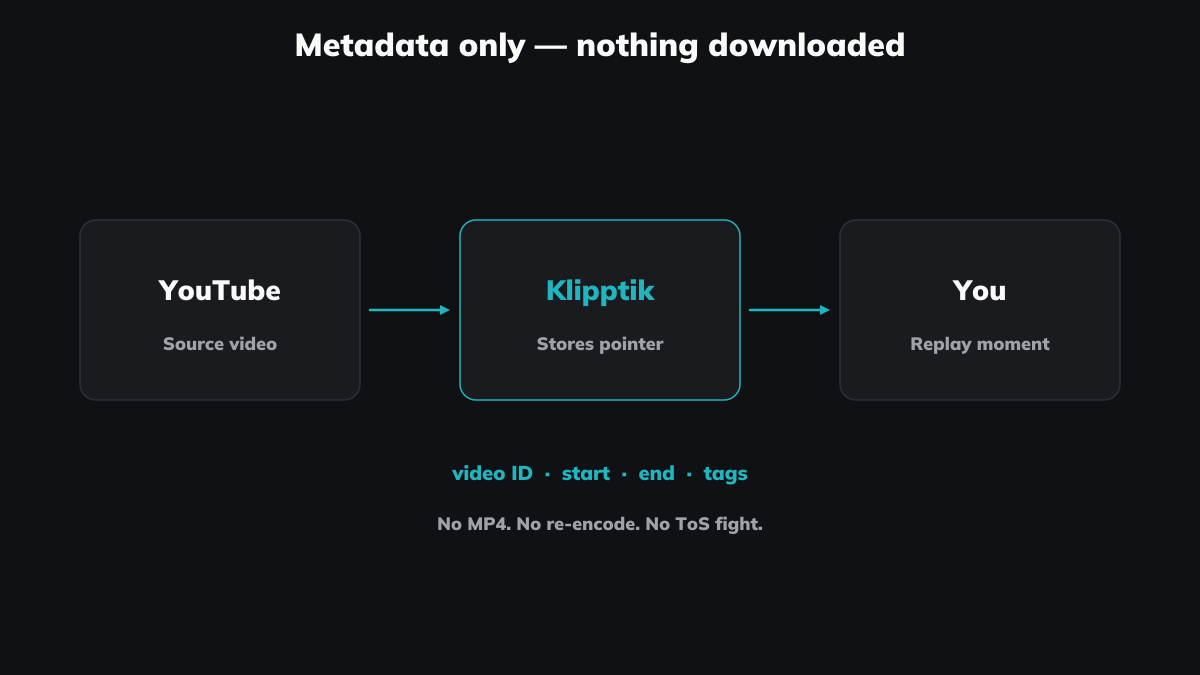
Where the video lives. Compliant clippers don't download video bytes. They use YouTube's IFrame Player API to embed playback — the video stays on YouTube and streams from YouTube every time you watch it. Developer Policy is explicit: "any technology other than YouTube API Services to access or retrieve API Data, including to access any portion of any YouTube audiovisual content" is prohibited. There is no "compliant downloader." It's not a category that exists.
What the tool stores. Compliant clippers store metadata: video URLs, your start and end timestamps, your tags, your notes. Nothing else. The video itself stays where it lives. You're not saving Sam Harris's three-hour interview; you're saving the address of the seven minutes in it you want to find again.
Klipptik scores positively on both — plus we're multi-source by design: YouTube and local files today, more online sources coming. Your library doesn't ride on any one platform staying up. We're not the only compliant option, though. Reclipped takes a similar IFrame-plus-metadata approach, focused on text annotation rather than standalone clips. Different feature set, same survival logic. The compliant path isn't unique to us; it's narrower than the SERP makes it look.
The honest limits
The compliant approach costs you a few things, and we'd rather tell you than have you find out later.
Online clips are stream-only. YouTube clips load fresh from YouTube every play; if your wifi goes down, they're unreachable. Local file clips still play — they live on your device. The same trade-off will apply to other online sources as we add them.
The server-proxy architecture adds roughly 100ms — one-tenth of a second — to each API call compared to a browser-direct fetch. Most people don't notice. We made the trade deliberately.
Your library should outlast the tool that built it — and the platforms it points to.
Use a clipper built to last. Free, no account required.